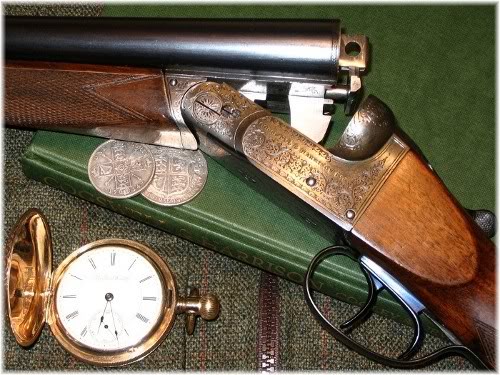
The 2007-08 hunting season was going to be something of an experiment for me, as was the season before. In 2006 I bought a .410 to attempt to gore the sacred ox that says it isn't an adequate sporting arm. And gore it I did. The following season I was lured to the mystique of the sixteen gauge. Initially I shopped for a classic American double. For a while I have wanted a Philadelphia Fox gun so that is what I targeted. A couple of months of shopping left me somewhat discouraged. There were guns out there but anything I thought was priced reasonably looked at though it had been used as a boat paddle. I ended up plunking down less money for a 1914 London ejector gun from Cogswell & Harrison with modern stock dimensions. At 6 1/4 pounds over a solid pad it isn't a super lightweight gun but it isn't exactly heavy either. For good shooting most people wouldn't want a gun much lighter than that anyway. It was a good decision.
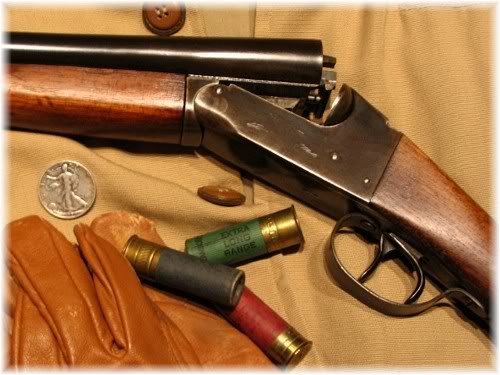
I like to have a backup gun for the worst of weather. I know many people feel comfortable taking anything they own out in any weather but I am not one of those people. When it rains I take a backup gun. The one I chose for that purpose was a 1929 Ithaca Western Arms Long Range model. As with the English gun this one has 28" barrels but it is choked mod/full instead of 1/4 & 1/2. The extra choking of this gun was an asset as I spent much of the season hunting open mud flats where there was little cover. The birds were often quite wary and there were days when if I was going to shoot at all it would be at birds flushing at forty yards. Those were the close birds. I enjoyed using the gun even though it bests the weight of the Cogswell & Harrison by a full pound.
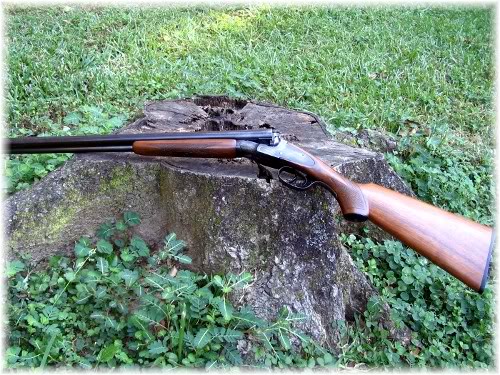
The third gun I bought was a Field grade L.C. Smith Featherweight made in the late 1940's. Compared to the other guns this one would be considered modern and is fully capable of handling any ammo loaded to SAAMI specifications. It was an impulse buy and I just happened to see it on the dealer's rack when I went in to pick up a twenty gauge Fox that I had shipped there. It is an ejector gun with 28" barrels choked mod/full. The weight falls halfway between the Cogswell & Harrison and the Ithaca. As of today the gun has only been out in the field a few times and I still haven't used it enough to decide how much I like it. I'm sure the more I shoot it the better I will like it.
Next came the task of what to feed the guns. The Cogswell & Harrison has 2 1/2" chambers, the Ithaca 2 9/16", and the L.C. Smith 2 3/4". Initially all I shot was 2 1/2" cartridges that I loaded but early in the hunting season I bought a case of 500 67mm cartridges to shoot in the Ithaca. They are loaded with 27 grams of shot, which is just under an ounce. All of the Cartridges I loaded contained 7/8 ounces of shot. In those cartridges I found the density of #8 shot to perform better than the larger #7 1/2. At longer ranges there were fewer holes in the pattern of the ones loaded with #8 and they still contained plenty of downrange energy to penetrate, break bones, and kill birds. If I could have picked up a bag of #8 1/2 I believe I would have been very pleased with the performance.
When all was said and done I had a season in which I shot more birds than any prior. However, I also had a lower percentage of hits than in any other season since I have been keeping track of such things. Does that mean I shoot a sixteen worse than a twenty, twenty-eight, or (heaven forbid) a four-ten? No, much of that can be chalked up to tougher hunting conditions and switching back and forth from day to day between guns with drastically different feel and stock dimensions. If I concentrated on one and only one of those guns I could use it just as effectively as a twenty gauge and with slightly more effectiveness than a twenty-eight gauge. But, where would the fun be in just shooting one gun?